Hidden Renovation Materials: Demo Protection, Water Pipes, Electrical Wires and Breakers
- Marcus Lim
- May 27
- 8 min read

Hidden Renovation Materials: Demo Protection, Water Pipes, Electrical Wires and Breakers
Many homeowners focus on the visible parts of renovation.
Tiles, countertops, carpentry, paint, lighting and furniture are easy to see.
But some of the most important renovation materials are hidden behind walls, under floors, above ceilings or inside distribution boxes.
These hidden materials can affect safety, comfort, maintenance and long-term reliability.
Before renovation starts, homeowners should understand the basics of demo protection, water pipes, electrical wires and breakers.
Why Hidden Materials Matter
A renovation is not only judged by what looks nice on handover day.
It should also be planned properly behind the scenes.
Water pipes, electrical wiring, circuit protection, waterproofing, hacking control and site protection may not be obvious in photos, but they affect how the home performs every day.
Poor hidden works can lead to water leaks, tripping issues, messy future repairs, unsafe electrical loading, damaged common areas or disputes during renovation.
This is why hidden renovation materials should not be treated as minor details.
Demo Protection Before Renovation Starts
Before hacking or demolition works begin, the site should be prepared properly.
Demo protection helps reduce damage to areas that should not be affected by the renovation.
It can also help keep common areas cleaner and reduce unnecessary disputes with neighbours, building management or homeowners.
Protection is especially important for condo renovation, HDB renovation, commercial renovation and landed homes where certain areas must remain undamaged.
Common Types of Demo Protection
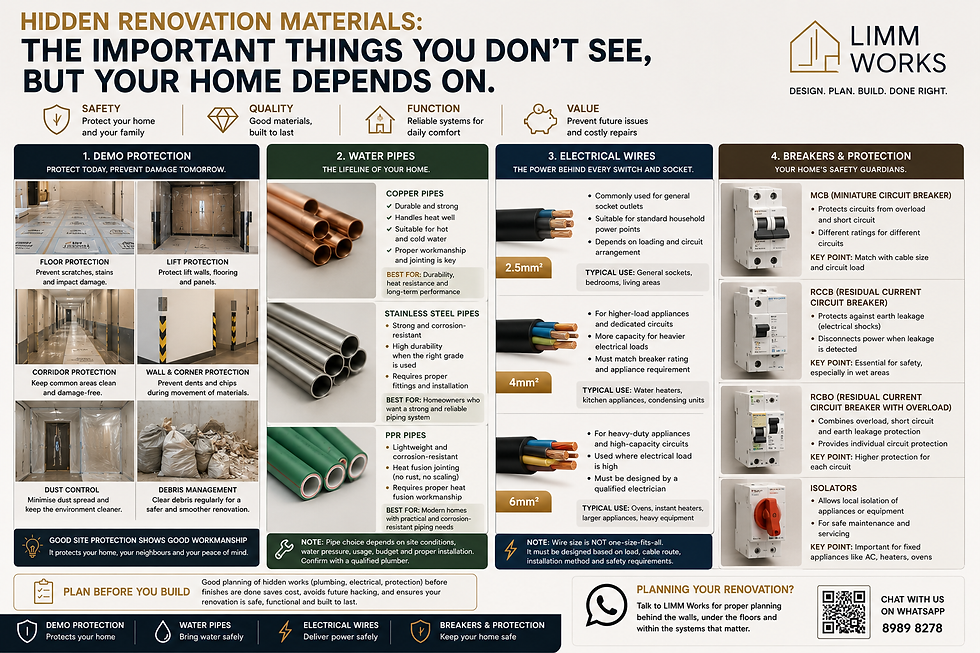
Common demo protection may include floor protection, lift protection, corridor protection, wall corner protection, door frame protection, dust control and covering of existing items.
For condo and HDB renovation, lift and corridor protection may be required by management or building rules.
For landed homes, protection may be needed around access paths, staircases, existing finishes, car porch areas and neighbouring boundaries.
For commercial renovation, protection may be needed for shared corridors, loading areas, lift lobbies and existing building finishes.
Floor Protection
Floor protection helps reduce scratches, stains and impact damage during renovation.
Depending on the site condition, protection may involve corrugated sheets, plywood, plastic sheets, protective boards or other suitable covering materials.
The correct method depends on the existing floor, renovation scope and movement of workers and materials.
For example, heavy tile deliveries or carpentry installation may require stronger protection than light painting works.
Protection should be planned based on actual site activity, not only appearance.
Lift and Corridor Protection
For condo, HDB and commercial buildings, workers often need to move materials through common areas.
This can include tiles, boards, sanitary fittings, carpentry, tools, debris and appliances.
Lift and corridor protection helps prevent damage to shared spaces.
It also shows proper renovation discipline.
If protection is not done properly, management may stop works, request rectification or deduct from renovation deposits.
Dust and Debris Control
Hacking and demolition can create dust and debris.
Dust control may involve covering openings, sealing certain areas, using plastic sheets, clearing debris regularly and controlling the work area.
This is especially important when renovation is only done in part of a home or when some areas are already completed.
Good site control helps the renovation progress more cleanly.
Water Pipes in Renovation
Water pipes are one of the most important hidden materials in a home.
They affect kitchen, bathroom, laundry, water heater, tap points, shower points and other wet areas.
During renovation, plumbing works may involve replacing old pipes, relocating water points, adding new water points or coordinating pipe routes with carpentry and tiling.
Common pipe materials discussed in Singapore renovation include copper pipes, stainless steel pipes and PPR pipes.
The right choice depends on site condition, project requirements, budget, installation method and suitability.
Copper Pipes
Copper pipes have been widely used for plumbing works over the years.
They are known for durability and strength when properly installed.
Copper can handle heat well and is often associated with a more traditional plumbing system.
However, copper pipes can be more expensive than some alternatives.
They also require proper workmanship and jointing.
If not installed or protected correctly, corrosion or joint issues may still occur depending on site condition and water quality.
When Copper Pipes May Be Used
Copper may be considered when durability, heat resistance and proven long-term use are important.
It may be suitable for certain hot and cold water applications depending on project requirements.
However, the final choice should be confirmed by the plumber based on the site condition and requirements.
Stainless Steel Pipes
Stainless steel pipes are also used in some plumbing applications.
They are known for strength and corrosion resistance when the right grade and system are used.
Stainless steel can give homeowners confidence because it feels strong and durable.
However, stainless steel systems can also cost more and require proper fittings and installation.
The performance depends on product quality, correct grade, jointing method and workmanship.
When Stainless Steel Pipes May Be Used
Stainless steel pipes may be considered for homeowners who want a strong and durable piping option.
They may be used depending on plumbing design, project budget and installation suitability.
As with all plumbing materials, correct installation matters as much as the material itself.
PPR Pipes
PPR pipes are commonly used in many modern plumbing works.
They are lightweight, corrosion-resistant and joined using heat fusion.
PPR is often used for water supply lines in residential renovation when suitable.
One advantage of PPR is that it does not corrode like metal pipes.
However, PPR requires proper heat fusion workmanship.
Poor jointing, wrong installation or poor support can still create future problems.
When PPR Pipes May Be Used
PPR pipes may be suitable for many residential water supply applications, depending on the site and plumbing requirements.
They can be practical for homeowners who want a modern, corrosion-resistant piping system.
However, pipe routing, support, pressure, heat requirements and installation quality should be considered carefully.
Important Plumbing Note
Homeowners should not choose pipe materials based only on online comparisons.
The right pipe material depends on site conditions, water pressure, hot or cold water use, existing pipe routes, accessibility and installation requirements.
A qualified plumber should review the project before deciding the final pipe type and installation method.
Electrical Wires in Renovation
Electrical wiring is another important hidden part of renovation.
It affects lighting, power sockets, air-conditioning, water heaters, kitchen appliances, ovens, hobs, dryers and other electrical loads.
During renovation, homeowners may need new points, relocated switches, additional sockets, dedicated appliance points or rewiring.
Wire size matters because different loads require different cable capacities.
Common Wire Sizes Discussed in Home Renovation
Common wire sizes homeowners may hear about include 2.5mm², 4mm² and 6mm² cables.
These sizes are often discussed for different electrical points and appliances.
However, homeowners should treat this as general information only.
The final cable size, breaker rating and circuit design must be confirmed by a qualified electrician based on the actual load, installation condition and applicable requirements.
2.5mm² Electrical Wire
2.5mm² wire is commonly associated with general socket outlets and many standard power point applications.
It may be used for typical household socket circuits depending on the electrical design.
This does not mean every socket should automatically use the same setup.
The electrician must consider loading, circuit arrangement, installation method and safety requirements.
When 2.5mm² Wire May Be Used
2.5mm² wire may be suitable for general power sockets, normal household use and standard appliance points where the load is within the designed circuit capacity.
Examples may include general room sockets, common appliance points and normal home use.
The final decision should always be made by the electrician.
4mm² Electrical Wire
4mm² wire is often discussed for higher-load appliances or dedicated circuits.
It may be used where the electrical load is higher than normal general socket use.
Examples may include certain kitchen appliances, water heaters or equipment that needs more capacity, depending on the design.
However, cable size alone is not enough.
The breaker, load, circuit route and installation condition must all match.
When 4mm² Wire May Be Used
4mm² wire may be considered for higher-load points or dedicated circuits where required.
This depends on the appliance requirement, circuit design and electrician’s assessment.
Homeowners should confirm appliance specifications early so the electrician can plan properly.
6mm² Electrical Wire
6mm² wire is often discussed for heavier loads.
It may be used for larger appliances or higher-capacity circuits, depending on the requirement.
Examples may include certain ovens, instant heaters, larger equipment or heavier electrical loads.
Again, this is not a fixed rule for every home.
The correct cable size must be designed by a qualified electrician.
When 6mm² Wire May Be Used
6mm² wire may be considered when the electrical load is high and the circuit requires larger capacity.
This may apply to selected appliances or specific renovation requirements.
The electrician should confirm based on load, breaker, cable route and safety requirements.
Why Wire Size Cannot Be Chosen Casually
Electrical wire size should not be guessed.
Using the wrong cable size can create safety risks.
If the cable is undersized for the load, it may overheat.
If the breaker and cable are not matched properly, the protection may not work as intended.
If too many appliances are placed on one circuit, tripping or overload issues may happen.
This is why electrical planning should be done carefully before renovation works start.
Breakers and Electrical Protection
Breakers are designed to protect electrical circuits.
They help reduce risk when there is overload, short circuit or leakage, depending on the type of protection used.
Homeowners may hear terms such as MCB, RCCB, RCBO, isolator and distribution board.
These items are not decorative.
They are part of the home’s electrical safety system.
MCB
An MCB, or miniature circuit breaker, is commonly used to protect circuits from overload and short circuit.
Different circuits may use different ratings depending on the electrical design.
The rating should match the cable size and circuit requirement.
RCCB
An RCCB is used for earth leakage protection.
It helps detect leakage current and disconnect supply when needed.
This is important for electrical safety, especially in areas involving water or metal appliances.
RCBO
An RCBO combines overload, short circuit and earth leakage protection for a circuit.
It can provide more individualised protection compared to some traditional setups.
Whether RCBOs are suitable depends on the electrical design and budget.
Isolators
Isolators are used for certain appliances or equipment that require separate local isolation.
Examples may include air-conditioning units, water heaters, ovens or other fixed appliances depending on the installation requirement.
They allow power to be isolated for servicing or safety.
Why Breaker Planning Matters
Breaker planning should match how the home is used.
A kitchen with many appliances may need proper dedicated circuits.
A bathroom with water heater requirements needs careful electrical planning.
An air-conditioning system needs proper isolation and circuit planning.
If breakers and circuits are not planned properly, homeowners may face tripping issues or unsafe loading.
Hidden Works Should Be Planned Before Finishes
Water pipes and electrical wires should be planned before tiles, carpentry, ceiling works and final finishes are installed.
Once the works are covered, future changes become more difficult and costly.
This is why homeowners should confirm appliance locations, kitchen layout, bathroom layout, storage needs, water points and electrical points early.
Good hidden works planning makes the visible renovation smoother.
How LIMM Works Coordinates Hidden Renovation Works
LIMM Works Pte Ltd provides residential renovation, landed renovation, A&A works and commercial renovation in Singapore.
Our renovation works are supported by our own in-house trade teams covering demolition, electrical, plumbing, tiling, false ceiling and carpentry works.
This helps us coordinate hidden works more clearly with visible finishes such as tiles, carpentry, lighting, countertops and bathroom fittings.
Our goal is to plan the work properly before everything is covered up.
What Homeowners Should Ask Before Renovation Starts
Before renovation begins, homeowners should ask practical questions.
What areas need protection?
Will there be hacking or demolition?
Are old pipes being replaced?
Are new water points needed?
Are electrical points being added or shifted?
Are there dedicated circuits for high-load appliances?
Are kitchen appliances confirmed?
Are bathroom fittings confirmed?
Will ceiling or carpentry hide future access?
These questions help reduce problems later.
Planning Renovation Works Behind the Scenes?
If you are planning home renovation in Singapore, speak with LIMM Works Pte Ltd.
Share your floor plan, site photos, appliance list, renovation scope, budget range and timeline.
We will review your requirements and advise on the next practical step.
Comments