Home Renovation Timeline in Singapore: From First Discussion to Handover
- Marcus Lim
- May 26
- 7 min read

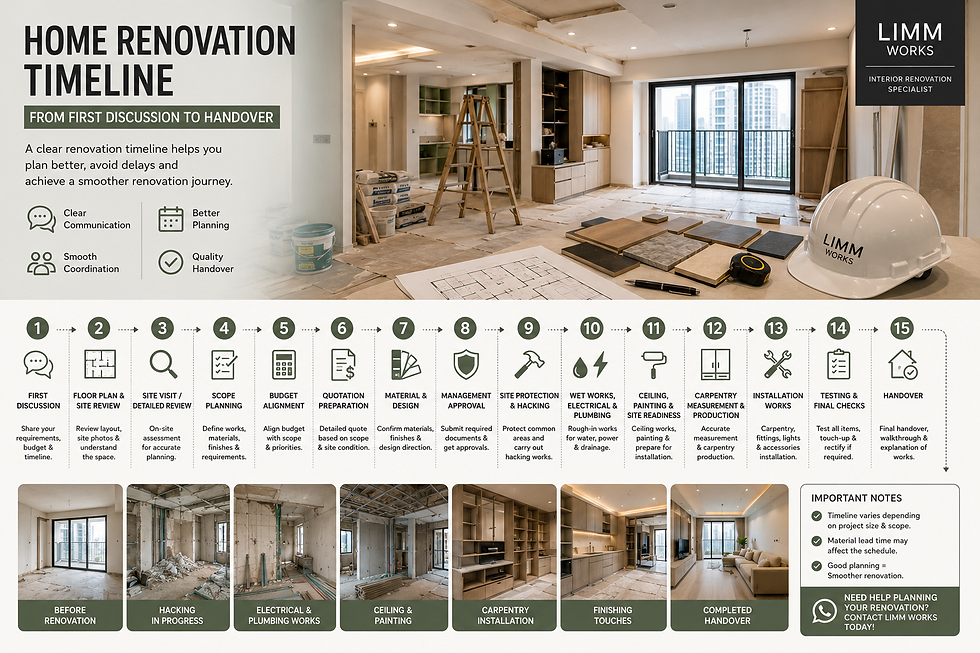
Home Renovation Timeline in Singapore: From First Discussion to Handover
A home renovation can feel overwhelming when homeowners are not sure what happens next.
Many people only think about the final result — the completed kitchen, bathroom, living room, wardrobes, lighting and carpentry.
But behind every completed renovation, there is a sequence of planning, coordination, site preparation, trade works, carpentry production, installation and handover.
Understanding the renovation timeline helps homeowners set clearer expectations before work begins.
**Why Renovation Timeline Planning Matters**
A renovation timeline is not only about how many weeks the project takes.
It is about knowing which stage comes first, which decisions must be made early, and which works depend on each other.
For example, carpentry measurement cannot be done properly if site works are not ready.
Electrical points should be planned before ceiling works and carpentry are finalised.
Bathroom and kitchen works need proper sequencing because they may involve hacking, plumbing, waterproofing, tiling and installation.
When the renovation timeline is planned properly, the project becomes easier to coordinate.
**Stage 1: First Discussion**
The first stage usually starts with a simple enquiry.
At this point, the homeowner may share the property type, floor plan, site photos, renovation scope, budget range and timeline.
For example, the enquiry may involve a condo renovation, HDB renovation, landed home renovation, kitchen renovation, bathroom upgrading or carpentry works.
This stage is important because it helps the renovation team understand the project direction before giving advice.
A better first discussion usually leads to a more useful next step.
**Stage 2: Floor Plan and Site Photo Review**
Before any proper quotation or planning can happen, the renovation team needs to understand the existing space.
A floor plan shows the layout.
Site photos show the real condition.
Both are useful.
The floor plan helps identify room sizes, wall positions, kitchen and bathroom locations, circulation and possible work areas.
Site photos help show the current finishes, ceiling, flooring, carpentry, wet areas, electrical points, windows, doors and existing problems.
For landed homes, exterior photos, roof areas, car porch, backyard and drainage areas can also be important.
For condo and HDB homes, photos of the kitchen, bathrooms, living room and existing carpentry are useful.
**Stage 3: Site Visit or Detailed Review**
For some projects, a site visit is needed before confirming scope.
This is especially useful when the renovation involves hacking, wet works, plumbing changes, bathroom works, kitchen works, carpentry, old-house conditions or commercial renovation requirements.
During a site visit, the team can better understand access, existing condition, measurement concerns, material movement, building rules and possible site limitations.
A site visit does not solve everything immediately, but it gives a clearer basis for planning.
For larger projects, this stage can prevent many assumptions later.
**Stage 4: Scope Planning**
After the first review, the renovation scope should be defined more clearly.
Scope planning means deciding what is included and what is not included.
This may cover:
Kitchen renovation
Bathroom renovation
Flooring
Painting
Electrical works
Plumbing works
False ceiling
Carpentry
Tiling
Doors
Windows
Lighting
Demolition or hacking
Site protection
Final cleaning and handover
Clear scope is important because renovation costs and timeline depend heavily on what needs to be done.
If the scope keeps changing, the quotation and schedule will also change.
**Stage 5: Budget Alignment**
Budget should be discussed early.
This does not mean every detail must be final from day one.
But the renovation team should understand the expected budget range so the proposed scope can match the homeowner’s priorities.
For example, a homeowner with a $50K budget and a homeowner with a $200K budget may need very different planning approaches.
The budget affects material selection, carpentry extent, kitchen works, bathroom works, electrical upgrades, finishing details and timeline.
A realistic budget discussion helps reduce wasted time and unrealistic planning.
**Stage 6: Quotation Preparation**
Once the scope is clearer, the quotation can be prepared.
A useful quotation should be based on the intended works, site condition, material direction and project requirements.
It should not be just a random number.
For some projects, the quotation may need further adjustment after material selection, site confirmation or design changes.
Homeowners should review what is included, what is excluded, what is provisional, and what needs confirmation later.
This stage is important because misunderstandings often happen when the scope is not clearly written.
**Stage 7: Material and Design Direction**
After the main scope and quotation direction are clearer, material and design choices can be developed.
This may include tiles, laminates, countertop, paint colours, flooring, lighting, sanitary fittings, kitchen appliances, carpentry finishes and general interior direction.
For homeowners, this is the stage where the renovation starts to feel more visual.
But material selection should still remain practical.
A material may look nice, but homeowners should also consider maintenance, durability, cleaning, moisture, usage and budget.
Good renovation planning balances appearance with daily usability.
**Stage 8: Management Approval and Pre-Site Preparation**
For condo and HDB renovation, management or permit requirements may apply.
Condo renovation may involve management approval, renovation deposit, insurance, lift protection, loading bay booking, renovation notice and working hour restrictions.
HDB renovation may involve HDB rules, hacking permits where applicable, contractor requirements and renovation timing.
Commercial renovation may involve landlord approval, building management rules, insurance, permit submissions, access control and handover conditions.
This stage should be handled before site works begin.
If approval or access is not prepared properly, the project may be delayed before work even starts.
**Stage 9: Site Protection and Hacking**
Before new works begin, the site may need protection and hacking.
Protection may include lift protection, corridor protection, floor protection, wall protection or covering areas that should not be damaged.
Hacking may involve removing old tiles, cabinets, walls, fixtures, ceiling, flooring or built-in items.
This stage can be messy, noisy and disruptive, but it is important.
A clean start helps the next trades work properly.
For LIMM Works, our own demolition team helps us manage site preparation and early-stage renovation works with better coordination.
**Stage 10: Wet Works, Electrical and Plumbing**
After hacking and preparation, the project may move into wet works, electrical and plumbing.
Wet works may include tiling, screeding, masonry, waterproofing and bathroom or kitchen preparation.
Electrical works may include lighting points, power points, switches, data points, appliance points and wiring adjustments.
Plumbing works may include water supply, drainage, sink points, bathroom fittings, heater points and kitchen plumbing.
These works are important because many of them will be hidden behind finishes later.
Planning and checking at this stage matters.
**Stage 11: Ceiling, Painting and Site Readiness**
Once the earlier trade works are ready, the project may move into ceiling works, painting and preparation for installation.
False ceiling works may be needed for lighting, air-conditioning, design features or concealment.
Painting gives the space its base finish.
At this stage, the site also needs to become ready for carpentry installation and other finishing works.
If the site is not ready, carpentry installation can be delayed.
This is why sequencing is important.
**Stage 12: Carpentry Measurement and Production**
Carpentry measurement should happen at the correct stage.
Kitchen cabinets, wardrobes, TV consoles, shoe cabinets, vanity cabinets and storage systems need accurate site measurements.
If measurements are taken too early, later site changes may affect the final fit.
At LIMM Works Pte Ltd, carpentry is supported by our own local carpentry factory.
This helps us coordinate measurement, production and installation more clearly with the project team.
Carpentry production takes time, so it should be planned properly within the renovation schedule.
**Stage 13: Installation Works**
Installation is where many visible parts of the renovation come together.
This may include carpentry, lighting, sanitary fittings, kitchen fittings, appliances, doors, glass works, mirrors, accessories and other finishing items.
This stage requires careful coordination because many trades may need to return to site.
For example, after carpentry is installed, electrical works may need final connection.
After vanity installation, plumbing may need final fitting.
After lights are installed, testing is needed.
The project should not be rushed at this stage because final details affect the overall result.
**Stage 14: Testing, Touch-Up and Final Checks**
Before handover, the renovation should go through checking.
This may include:
Testing lights and switches
Checking power points
Checking plumbing fittings
Checking cabinet doors and drawers
Checking tile finishes
Checking paint touch-ups
Checking silicone and joints
Checking accessories
Checking cleaning condition
Checking defects or outstanding items
This stage is important because small issues are easier to resolve before full handover.
A proper final check gives the homeowner more confidence before moving in.
**Stage 15: Handover**
Handover is the final stage.
At this point, the major works should be completed, the space should be cleaned, and the homeowner can review the final condition.
Handover may include explaining key areas, reviewing completed works, noting outstanding minor touch-ups if any, and confirming next steps.
A good handover should not feel rushed.
It should give the homeowner a clear understanding of what has been completed and what to look out for.
**How Long Does Home Renovation Usually Take?**
The renovation timeline depends on property type, scope and site condition.
A small partial renovation may take a few weeks.
A full HDB or condo renovation may take longer depending on hacking, kitchen, bathroom, carpentry and material lead time.
A landed renovation or A&A project may take much longer because of larger scope, multiple floors, external areas, wet works, roofing, drainage, structure, access and sequencing.
Commercial renovation depends on unit size, building rules, fit-out scope and business deadlines.
Instead of focusing only on the number of weeks, homeowners should focus on whether the scope and schedule are realistic.
**Why Rushing Can Create Problems**
Many homeowners want renovation to finish quickly.
That is understandable.
But rushing the wrong stages can create problems.
Wet works need time.
Waterproofing needs proper preparation.
Carpentry needs measurement and production time.
Paint and finishing need touch-up.
Electrical and plumbing need testing.
If everything is forced too tightly, mistakes and rework may happen.
A realistic timeline gives the project a better chance of finishing properly.
**How LIMM Works Manages Renovation Timeline**
LIMM Works Pte Ltd provides residential renovation, landed renovation, A&A works and commercial renovation in Singapore.
Our projects are supported by our own local carpentry factory and in-house trade teams covering demolition, electrical, plumbing, tiling, false ceiling and carpentry works.
This helps us coordinate the renovation process more clearly across different stages.
Our focus is to define the scope, plan the sequence, coordinate the trades and manage the work toward proper handover.
**Planning a Home Renovation?**
If you are planning a home renovation in Singapore, speak with LIMM Works Pte Ltd.
Share your property type, floor plan, site photos, project scope, budget range and timeline.
We will review your requirements and advise on the next practical step.


Comments